

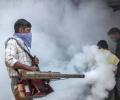
As the issue becomes increasingly politicised and accusations are traded on national television, the average Delhi resident suffers debilitating blows from viral fevers, writes Manavi Kapur.
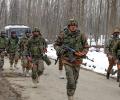
'A couple of Pulwamas will bring the two nations to war and it will be limited to J&K itself.'

Will China's new military reforms endanger Xi Jinping's rule?
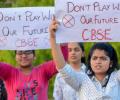
Incidents like these are a wake-up call, says School Education Secretary Anil Swarup. 'Today, if a particular problem has been found, technology allows solutions to address it,' he says, suggesting alternatives such as printing and distribution of encrypted question papers on the day of the exam. Swarup wants electronic tracking to keep tab on who has access to and can, therefore, leak papers.

'India does not wish to remain silent in improving its strategic space so that its leverage to counter China's expansionist designs is maintained, besides enabling it to play a responsible role from a position of strength for peace and stability in Asia,' points out Dr Rajaram Panda.

The known unknowns in Prime Minister Modi's Saudi visit assume great significance, says Ambassador M K Bhadrakumar.

'I would personally like to see Rahul Gandhi continue as party president.' 'I genuinely believe he has far more to offer to the party still, particularly in leading us in these challenging times that we find ourselves in.'

After the United Nations declared June 21 as the International Yoga Day in December last year at India's request, the officers in the Ministry of Ayush began ideating about how to celebrate it in the country.

India's silence on this week's troubles in the Maldives is puzzling, says Rajeev Sharma.

The banking sector in India is reeling under Rs 8 lakh crore of non performing assets (NPAs) or bad loans, of which PSU banks alone account for over Rs 6 lakh crore.
Naresh Chandra, former cabinet secretary, diplomat and well-known strategic thinker, tries to explain what the Modi government is up to and assesses what will work and what may not work and why. He spoke to Sheela Bhatt/Rediff.com, also, on diplomatic issues.

Sheikh Hasina's government has launched a relentless war against terrorism since the Dhaka cafe carnage in July 2016, but as Bangladesh's terror networks exploit new technologies and new tactics, the challenge to eliminate jihad gets tougher, points out Binodkumar Singh.

"The poor will not suffer disproportionately due to bouts of sharp inflation, and the middle class will not see its savings eroded," Raghuram Rajan said.

'Overlying his idealism was a hatred of war and of all things military. He gave no deep thought to politico-military matters and this prevented him from making sound security decisions.'
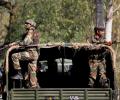
'More needs to be done in less time,' says Vivek Gumaste. 'A sense of urgency is crucial if the BJP wishes to fulfil its promise of tough, no-nonsense, governance in matters of security.'

Indian regulators have identified certain groups as 'financial conglomerates' and they are being monitored closely for any systemic risks they may pose.

India could gain four times over by winding up dysfunctional subsidies.

Affaq Husain and his wife Saira built a Rs 100 crore empire preying on the most vulnerable people in society.

'Only on two occasions has the RSS thrown itself completely on the side of the BJP.' 'In 1977 in the wake of the Emergency. And in 2014 with Modi.' 'Now, I've been told that this is not going to happen in 2019.'

There are just 1,500 drug inspectors responsible for more than 10,000 factories in India

'Tax dodging through tax havens is one of the ways multinational corporations and the super-rich in India are using to evade taxes.'
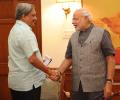
The National Democratic Alliance government has adopted half measures instead of moving decisively on defence.

This is the joint statement issued by the ministry of external affairs on the visit of US President Barack Obama to India.

Modi is optimistic that the reforms will be passed soon.

Hindu-American Congresswon Tulsi Gabbard coasts to a rollicking re-election victory in in Hawaii's 2nd District

New Delhi and Beijing are the only two regional capitals that have commented on US President Donald Trump's speech on August 21 outlining the way forward in Afghanistan. The Indian foreign ministry statement was effusive in praise, while the Chinese statement has been one of cautious and guarded hope. Delhi has identified itself with Trump's Afghan strategy, whereas the Chinese stance is calibrated -- observant and objective, keeping a distance, says Ambassador M K Bhadrakumar.

Are the ChildLine booths for runaway children an attempt to sanitise Indian railway stations or a genuine effort for the protection of 'railway kids'?
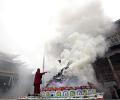
China has been keeping tabs on the restive Tibet province through a 'grid' system and some 600 'convenience police posts' armed with high-tech equipment that monitor the daily life of the citizens of Lhasa and other Tibetan towns. Worse, 'volunteer security groups' known as 'Red Armband Patrols' are roaming around in order to get more information and 'classify' each and every citizen, says Claude Arpi

Like China, India needs to encourage 'hacker clubs' in view of the challenges of virtual terrorism, says Lieutenant General Prakash Katoch (retd)

'Let us also not expect that there will be a clean break with the past, much though the new government might like to think about it. In a functional democracy that is neither feasible nor desirable. But basic change it must be,' says Shreekant Sambrani.

'The partnership of Amit Shah and Narendra Modi has made their biggest mistake. They have been very successful for their party in the last two years, but this batting pair has made the biggest political mistake of their life so far, which is calling Kejriwal a chor. It will backfire on them.'

'It was only relatively recently that Subhash Kapoor was able to secure the sources in India, Afghanistan and Cambodia, that allowed him to get the really highest level objects, and that helped propel him in recent years up the ranks.'

The government has provided a long-term vision.
 © 2026 Rediff.com - Advertise with us - Disclaimer - Privacy Policy - Sitemap - Feedback - About us - Terms of use - Grievances